Nikiski, AK
Travel Guide
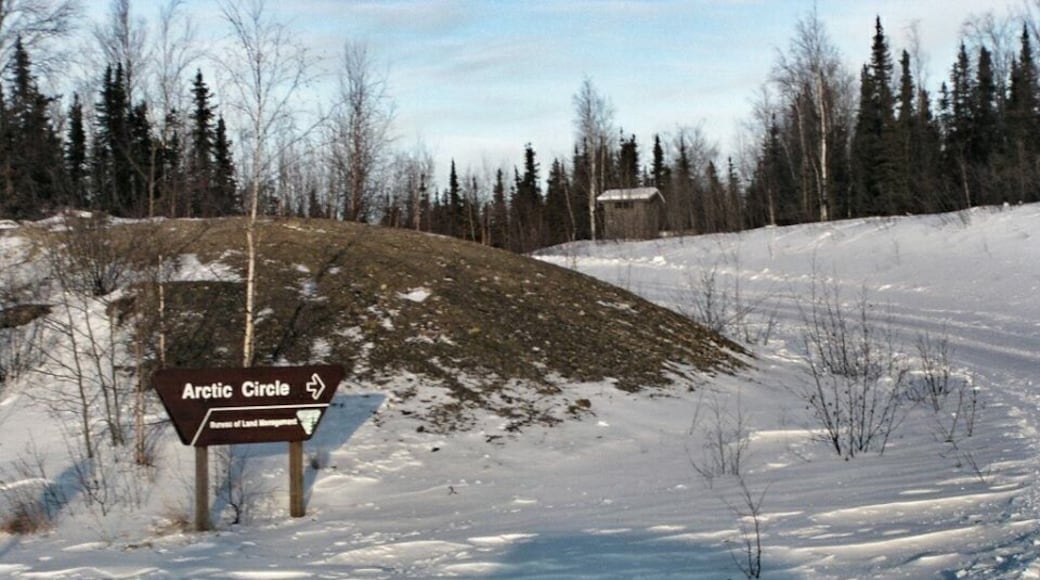
![The Arctic Circle is one of the five major circles of latitude that mark maps of the Earth. As of 16 February 2015, it runs 66°33′45.6″ north of the Equator.
The region north of this circle is known as the Arctic, and the zone just to the south is called the Northern Temperate Zone. The equivalent polar circle in the Southern Hemisphere is called the Antarctic Circle.
The Arctic Circle is the southernmost latitude in the Northern Hemisphere at which the sun can remain continuously above or below the horizon for 24 hours (at the June solstice and December solstice respectively). North of the Arctic Circle, the sun is above the horizon for 24 continuous hours at least once per year (and therefore visible at midnight) and below the horizon for 24 continuous hours at least once per year (and therefore not visible at noon). On the Arctic Circle those events occur, in principle, exactly once per year, at the June and December solstices, respectively. However, in practice, because of atmospheric refraction and mirages, and because the sun appears as a disk and not a point, part of the midnight sun may be seen on the night of the northern summer solstice up to about 50′ (90 km (56 mi)) south of the Arctic Circle; similarly, on the day of the northern winter solstice, part of the sun may be seen up to about 50′ north of the Arctic Circle. That is true at sea level; those limits increase with elevation above sea level, although in mountainous regions there is often no direct view of the true horizon.
The position of the Arctic Circle is not fixed. It directly depends on the Earth's axial tilt, which fluctuates within a margin of 2° over a 40,000-year period,[2] notably due to tidal forces resulting from the orbit of the Moon. The Arctic Circle is currently drifting northwards at a speed of about 15 m (49 ft) per year; see Circle of latitude for more information.
#snow](https://images.trvl-media.com/place/6140564/a9f9449e-bab4-40a6-a9a1-5356b0cc2aa8.jpg?impolicy=fcrop&w=1040&h=580&q=mediumHigh)
![The Arctic Circle is one of the five major circles of latitude that mark maps of the Earth. As of 16 February 2015, it runs 66°33′45.6″ north of the Equator.
The region north of this circle is known as the Arctic, and the zone just to the south is called the Northern Temperate Zone. The equivalent polar circle in the Southern Hemisphere is called the Antarctic Circle.
The Arctic Circle is the southernmost latitude in the Northern Hemisphere at which the sun can remain continuously above or below the horizon for 24 hours (at the June solstice and December solstice respectively). North of the Arctic Circle, the sun is above the horizon for 24 continuous hours at least once per year (and therefore visible at midnight) and below the horizon for 24 continuous hours at least once per year (and therefore not visible at noon). On the Arctic Circle those events occur, in principle, exactly once per year, at the June and December solstices, respectively. However, in practice, because of atmospheric refraction and mirages, and because the sun appears as a disk and not a point, part of the midnight sun may be seen on the night of the northern summer solstice up to about 50′ (90 km (56 mi)) south of the Arctic Circle; similarly, on the day of the northern winter solstice, part of the sun may be seen up to about 50′ north of the Arctic Circle. That is true at sea level; those limits increase with elevation above sea level, although in mountainous regions there is often no direct view of the true horizon.
The position of the Arctic Circle is not fixed. It directly depends on the Earth's axial tilt, which fluctuates within a margin of 2° over a 40,000-year period,[2] notably due to tidal forces resulting from the orbit of the Moon. The Arctic Circle is currently drifting northwards at a speed of about 15 m (49 ft) per year; see Circle of latitude for more information.
#snow](https://images.trvl-media.com/place/6140564/a9f9449e-bab4-40a6-a9a1-5356b0cc2aa8.jpg?impolicy=fcrop&w=1040&h=580&q=mediumHigh)

Visit Nikiski

Aspen Hotel Soldotna
Comfortable room & soft, comfy bed.
Reviewed on 2026/1/10

Aspen Extended Stay Suites Kenai
Nice
Reviewed on 2026/1/6

Best Western King Salmon Inn
Did not eat breakfast
Reviewed on 2025/11/11

Alaska River Pirates Cabins
No indoor plumbing is nothing mentioned in ad. Only a construction site toilet system outside
Reviewed on 2025/7/30

Joy's Kenai River Cabins
Our stay was excellent. Joy and Tom were fantastic. They welcomed us and treated us as family. Joy reached out to me before our scheduled stay to keep me up to date and what to expect. She texed me when the cabin was ready and how to access the cabin and were to park. After we arrived and got settled ...
Reviewed on 2024/8/1
Popular places to visit
Kenai Visitors and Cultural Center
After visiting Kenai Visitors and Cultural Center, make a plan to see the other sights and activities in Kenai. Stroll along the area's riverfront or simply enjoy its seafood restaurants.
Kenai River Flats
Explore the great outdoors at Kenai River Flats, a lovely green space in Kenai. Stroll along the riverfront or visit the churches while you're in the area.
Cunningham Park
Explore the great outdoors at Cunningham Park, a lovely green space in Kenai. Stroll along the riverfront or seek out the fishing spots.
Challenger Learning Center
You can spend time exploring the galleries in Challenger Learning Center during your trip to Kenai. Amble around the area's riverfront, or seek out its fishing spots.
Cabin Lake
Commune with nature and explore the great outdoors at Cabin Lake during your travels in Nikiski. While you're in the area, stroll along the lakeside.
Kotsina Road
You can take time to visit Kotsina Road during your travels to Nikiski. Discover the volcano viewpoints while you're in the area.